I. Database Introduction
The Halo database is a database product meticulously crafted through independent research and development, adopting world-leading database technology and combining it with practical core production business system practices. The Halo database has advanced multi-mode database technology, capable of highly compatible with multiple mainstream databases, thereby greatly reducing system migration costs and risks. At the same time, the Halo database is 100% compatible with PostgreSQL; any system based on PostgreSQL can be seamlessly migrated to the Halo database.
II. Product Features
1. Unique Multi-Mode Parsing Engine Technology It can significantly reduce code modifications in migration projects. According to current actual production system practices, it can reduce code modifications by at least 95%, thereby greatly reducing migration costs and also significantly lowering migration risks.
2. Flexible and Diverse System Architectures (Read-Write Separation, Sharding) High availability, read-write separation cluster technology easily achieves architecture patterns such as read-write separation and Sharding. This gives the Halo database rich performance options, fully meeting actual business needs.
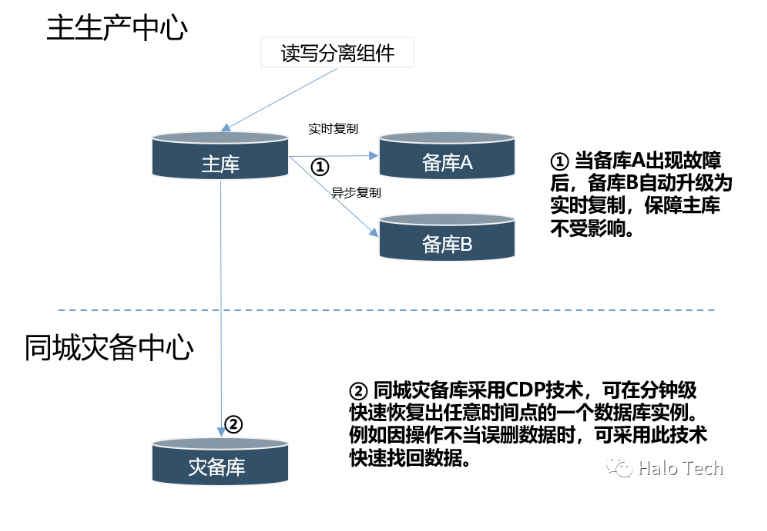
3. CDP Capability The Halo database can provide minute-level rapid data recovery capability at any point in time, helping enterprises quickly retrieve data and reduce business losses.
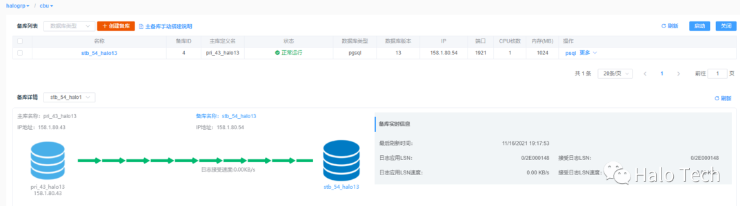
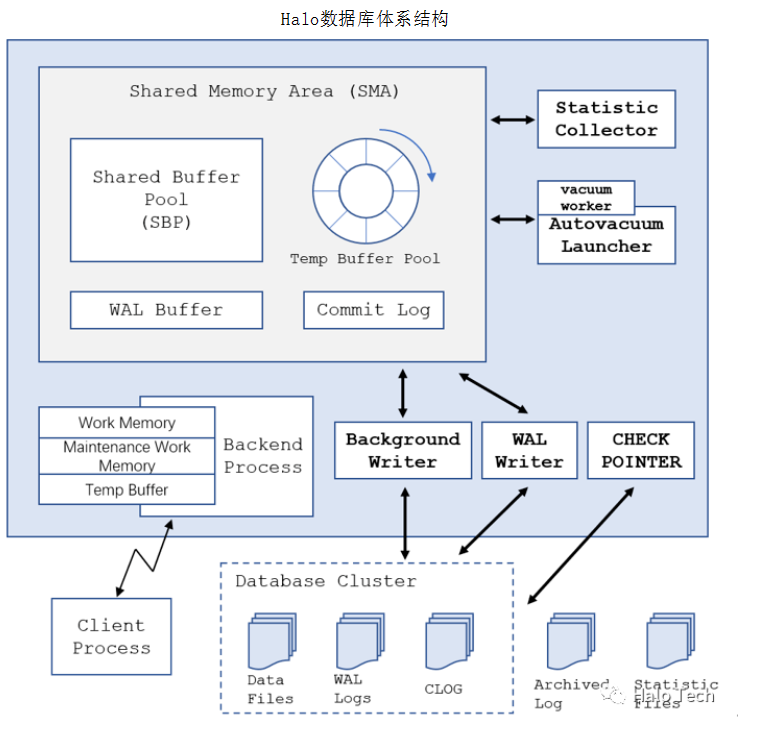
4. Disaster Recovery Capability, etc. The Halo database instance mainly consists of shared memory areas, local memory areas, and a series of background processes. The shared memory area mainly consists of shared cache and transaction log cache. Background processes mainly consist of Background Writer (data write process), WAL Writer (transaction log write process), Checkpointer (checkpoint process), Statistic Collector (statistical information collection process), Autovacuum (automatic cleanup process), and Backend Process (session process), etc. The database cluster mainly consists of data files, transaction log files, and some other auxiliary files.
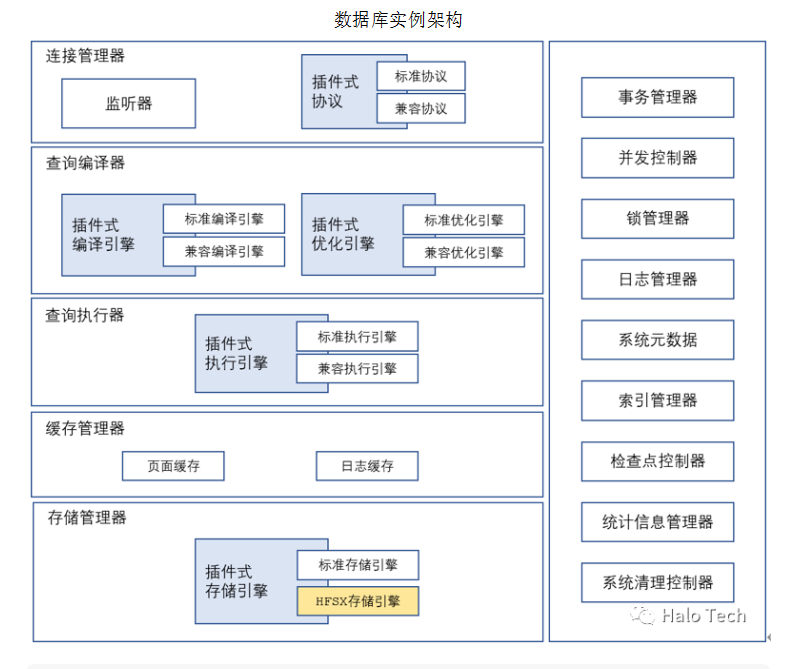
The main components of a Halo database instance. Through the design of a pluggable kernel, it can very flexibly achieve compatibility with multiple protocols, compatibility with multiple syntaxes, and support for distributed storage engines (HSM, technology in development), etc. This important feature is also a key reason why Halo can be called a new generation unified database.