1. Architecture Diagram
2. Description
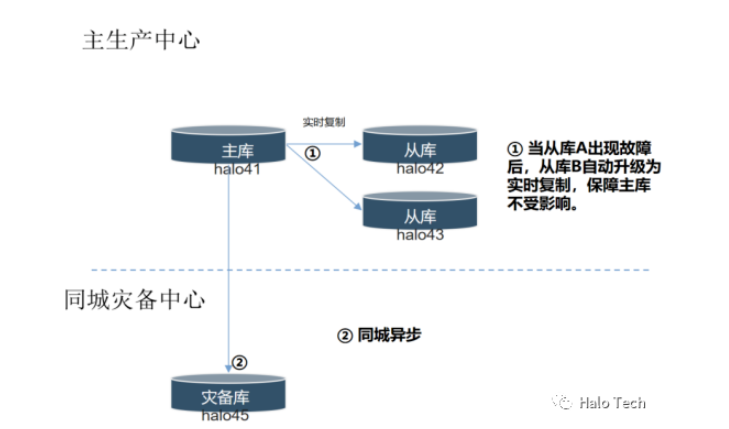
This feature allows for the implementation of group replication and local async cascading streaming replication within the same cluster. Each group can contain multiple nodes and set different synchronization levels.
To enable group replication, you must first configure the synchronous replication parameters synchronous_standby_names and synchronous_commit. Then, configure synchronous_standby_namesX and synchronous_commitX (where X is 1-4) as needed. The synchronization level set by synchronous_commitX must be lower than or equal to the level set by synchronous_commit.
Besides the primary group, up to four additional groups can be set. The main parameters involved are:
Configure the servers for group replication:
• synchronous_standby_names1 • synchronous_standby_names2 • synchronous_standby_names3 • synchronous_standby_names4
Configure different synchronization levels for each group:
• synchronous_commit1 • synchronous_commit2 • synchronous_commit3 • synchronous_commit4
3. Example
Prepare four servers
Primary Database halo41: 192.168.1.41
Standby Databases halo42: 192.168.1.42 halo43: 192.168.1.43 halo45: 192.168.1.45
Cluster High Availability Members: halo41, halo42, halo43. Local Async Disaster Recovery: halo45
4. Configuration Steps
4.1 Primary Database
4.1.1 Create Streaming Replication User
CREATE USER replica PASSWORD '123456' REPLICATION;4.1.2 Modify postgresql.conf
vi /data/halo/postgresql.conf
listen_addresses = 'localhost' change to listen_addresses = '*'

---- Group replication configuration:
synchronous_standby_names='1(halo42,halo43)'
synchronous_standby_names1='1(halo45)'
synchronous_commit=remote_apply
synchronous_commit1=on
4.1.3 Configure pg_hba.conf
vi /data/halo/pg_hba.conf
host replication     replica         0/0      md5
---- Steps 1, 2, and 3 require a database restart
pg_ctl restart4.1.4 Master-Slave Configuration
vi /etc/hosts
192.168.1.41 halo41   # Primary Database IP
192.168.1.42 halo42   # Standby Database IP
192.168.1.43 halo43   # Standby Database IP
192.168.1.45 halo45   # Local Disaster Recovery IP
4.2 Standby Database
4.2.1 Execute on Standby:
# 192.168.1.42:
pg_basebackup -F p -X stream -v -P -h 192.168.1.41 -U replica -D $PGDATA -R -C --slot halo42
pg_ctl start

# 192.168.1.43:
pg_basebackup -F p -X stream -v -P -h 192.168.1.41 -U replica -D $PGDATA -R -C --slot halo43
pg_ctl start

# 192.168.1.45:
pg_basebackup -F p -X stream -v -P -h 192.168.1.41 -U replica -D $PGDATA -R -C --slot halo45
pg_ctl start
4.2.2 Comment out the contents of the /data/halo/postgresql.auto.conf file on all standby databases

4.2.3 Modify the /data/halo/postgresql.conf file on the standby databases
# 192.168.1.42:
primary_conninfo = 'user=replica password=123456 channel_binding=prefer host=192.168.1.41 port=1921 sslmode=prefer sslcompression=0 sslsni=1 ssl_min_protocol_version=TLSv1.2 gssencmode=disable krbsrvname=halo target_session_attrs=any application_name=halo42'
-- Reload
pg_ctl reload

# Query
show primary_conninfo;# 192.168.1.43:
primary_conninfo = 'user=replica password=123456 channel_binding=prefer host=192.168.1.41 port=1921 sslmode=prefer sslcompression=0 sslsni=1 ssl_min_protocol_version=TLSv1.2 gssencmode=disable krbsrvname=halo target_session_attrs=any application_name=halo43'
-- Reload
pg_ctl reload
# Query
show primary_conninfo;# 192.168.1.45: Note that primary_conninfo should be configured in the postgresql.base.conf file
primary_conninfo = 'user=replica password=123456 channel_binding=prefer host=192.168.1.41 port=1921 sslmode=prefer sslcompression=0 sslsni=1 ssl_min_protocol_version=TLSv1.2 gssencmode=disable krbsrvname=halo target_session_attrs=any application_name=halo45'
-- Reload
pg_ctl reload
# Query
show primary_conninfo;4.3 High Availability
4.3.1 Start High Availability
systemctl start etcd
systemctl start patroni
4.3.2 Patroni Configuration for Groups and Patroni Not Deleting Local Streaming Replication Slot halo45
patronictl edit-config4.3.2.1 Group Streaming Replication
synchronous_commit: remote_apply
synchronous_commit1: local
synchronous_standby_names: 1(halo42,halo43)
synchronous_standby_names1: 1(halo45)
4.3.2.2 Patroni Does Not Delete Replication Slots
slots:
  halo41:
    type: physical
  halo42:
    type: physical
  halo43:
    type: physical
  halo45:
    type: physical
4.3.2.3 Cascading Replication Slots
ignore_slots:
  halo45:
    type: physical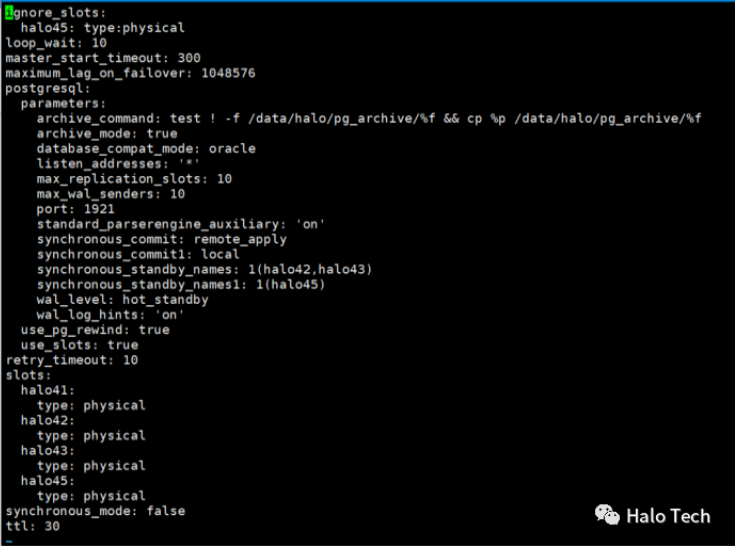
4.4 Query Streaming Replication on Primary Database
select * from pg_stat_replication;
show synchronous_standby_names;
show synchronous_standby_names1;
show synchronous_commit;
show synchronous_commit1;
4.5 Test Scenarios
4.5.1 Scenario One
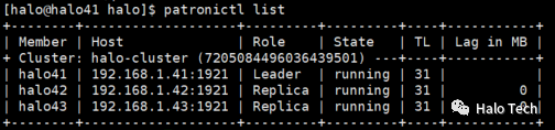
4.5.1.1 Halo41 is the Primary Node
As seen in the figure below, one of the nodes (halo42, halo43) is synchronized in real-time, and halo45 is a local async (async) database.

4.5.1.2 View patronictl list
4.5.2 Scenario Two
4.5.2.1 halo42 is the Primary Node, manually switched from halo41 to halo42
patronictl switchover4.5.2.2 View Streaming Replication on halo41

4.5.2.3 View Streaming Replication on halo42

4.5.2.4 View patronictl list
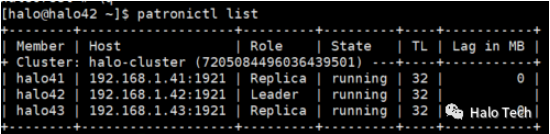
Summary: Halo42 is the primary database, synchronizing halo43 in real-time, and halo45 is a cascading streaming replication database.